|
THE SUNDANCE KID AND HENRY LONG MYSTERY
|
The Sundance Kid And Henry Long Continued...
1903 Henry's wife Luzernia Purchases some real estate in Henry’s Name but he is not present. Did he send her money and was he in Bolivia?
1907 Luzernia purchases some more real estate in Henry name and he is not present. Copies of these transactions are located in Loa Utah.
1908 It is believed by some that Harry Longabaugh "Sundance Kid" and Butch Cassidy were killed in a shoot out in San Vicente, Bolivia, but other people believe they returned to the United States. In 1993, a team of experts exhumed in Bolivia what they believed was the body of the Sundance kid, only to discover through DNA comparison that it was not Sundance at all. The Sundance Kid disappears from history.
1910 Henry Long reappears and is recorded in the 1910 Fremont Utah census record as “Head of Household”.
1936 William Henry Long dies and is buried in Duchesne Utah.
On Henry's Death Certificate his Birthplace is listed as Big Horn Basin, Wyoming. The Big Horn Basin was not settled until 1879 twelve years after his birth. At one time both Butch Cassidy and the Sundance Kid called the Big Horn Basin home, and the outlaw hideout, Hole In The Wall, is located in the Big Horn Mountains. His parents' birthplaces are listed as unknown, but his mother's given name Ann is recorded. Ann was also Harry Longabaugh's mother's given name.
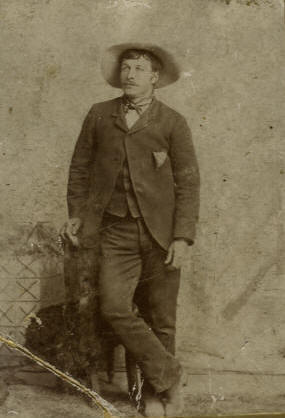
I own an Original photograph of Henry Long. It was passed down to me. I believe the photograph was taken before he married Luzernia Allred Morrell in 1894.
Henry Long
If Henry Long were Harry Longabaugh he was still a fugitive and this would explains his deceptions with the census takers and family members, how would he explain the Etta Place episode to family members? We were told Henry once rode with Butch Cassidy, and his name “William Henry Long” was an alias.
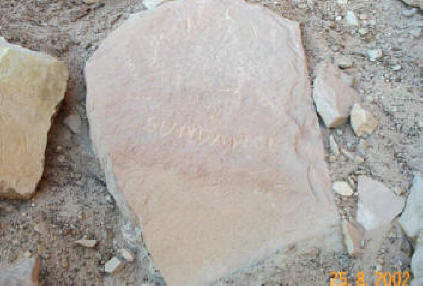
This "SUNDANCE" stone inscription is located in the Capital Reef National Monument in Utah. It is old and badly weathered. The engraving is about 18 inches long and 3 inches high.
There is also a Butch Cassidy inscription on a rock cabin near the "SUNDANCE" stone but it was plastered over in 1990 by the park service. My uncle, Perry Jackson, showed me both engravings in 1963. Kelly photographed the Cassidy engraving and it’s in his photograph collection at the Marriot library In Salt Lake City.
Here are other facts and a family story.
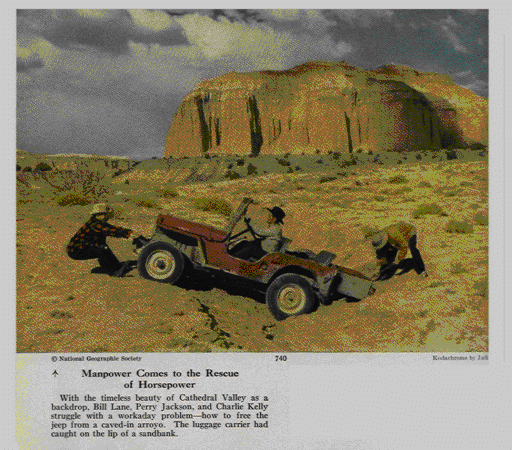
This is a photograph (below) of my Uncle Perry Jackson, which appeared in the June 1952 Issue of the NATIONAL GEOGRAPHIC MAGAZINE. Charles Kelly the author of "THE OUTLAW TRAIL" also appears in this photograph. At the time Kelly was superintendent of Capital Reef National Monument.
Please click on thumbnail to enlarge.
Henry Long had a dispute with a neighbor about irrigation water. Henry pistol-whipped the neighbor, leaving him bloody and unconscious. Henry then went to my grandfather, Jerry Jackson, and said he may have killed the neighbor, he told Jerry he was going to Hanksville Wayne, County, Utah and stay for three days. If he did not hear from Jerry, he would assume that the neighbor had died and he would then leave the country and not return. The neighbor survived, word was sent to Henry, and he returned to Freemont. Hanksville is a gateway to Robbers Roost. Henry was familiar with Robbers Roost, just like the Sundance Kid was, and he knew that once in Robbers Roost, he would be safe from the law.Just before his death Henry told family member he had buried some gold coins in a fire pit in the Robbers Roost in his outlaw days. The location was only accessible by horseback and he said he was to old to ride a horse that far so he drew them a map. Family members have searched for those few coins many times but never found them.
Jerry Nickle - A great-grandson of The Sundance Kid
NEXT: Tom McCarty To The Rescue
BACK: Home Page
Please e-mail me your comments.
Website Design by Phil Gottfredson ©sundancekidhenrylong.com Jerry Nickle All rights Reserved 2006